
IVDD Treatment in Dogs: Crate Rest, Surgery, and Safe Recovery at Home
Top 3 Takeaways
Introduction
When a dog is diagnosed with IVDD, families often hear several instructions at once: strict rest, pain medication, possible MRI or CT, possible surgery, bladder monitoring, and careful lifting. The difficult part is that these are not interchangeable choices. Medication may improve comfort before the damaged disc is stable. Crate rest may be appropriate for a walking dog with mild signs but unsafe as the only response to worsening weakness. Surgery can remove compressive disc material, but it still requires nursing care, restricted activity, and rehabilitation.
This guide focuses on the practical treatment questions owners face after the initial examination. It explains what strict crate rest means, how medical and surgical management differ, how to move a dog without twisting the spine, what to monitor at home, and where laser therapy or rehabilitation may fit. The dog’s veterinarian or neurologist must individualize the plan. Use written discharge instructions over generic timelines, and treat any loss of strength, walking ability, bladder control, or comfort as a reason for prompt reassessment.
If you are not sure whether your dog’s signs are an emergency, read IVDD in Dogs: Symptoms That Require Immediate Veterinary Care.
How Do Veterinarians Choose Medical Management or Surgery?
Medical management generally combines restricted activity with prescribed pain control and, when appropriate, anti-inflammatory medication. It is most often considered for dogs with pain alone, mild deficits, preserved walking ability, stable signs, or circumstances in which surgery is not pursued. The plan must include a neurologic baseline and clear instructions for what would count as treatment failure. A dog that becomes weaker, loses coordination, cannot walk, or remains severely painful despite medication needs re-evaluation rather than simply more time in the crate.
Surgical management usually involves advanced imaging followed by removal of disc material compressing the spinal cord. It is commonly discussed for nonambulatory dogs, severe or progressive deficits, uncontrolled pain, repeated episodes, or imaging showing significant compression. The exact procedure depends on whether the problem is in the neck or thoracolumbar spine and on the location of the material. Surgery also allows the specialist to confirm the lesion and physically decompress the cord, but it carries anesthesia, surgical, financial, and recovery considerations.
The decision is not based on one online success rate. Walking status, deep pain perception, duration and progression, location, recurrence, concurrent disease, and the family’s ability to provide nursing care all matter. Ask what outcome is realistic with each pathway for your dog today.
What Does Strict Crate Rest Actually Mean?
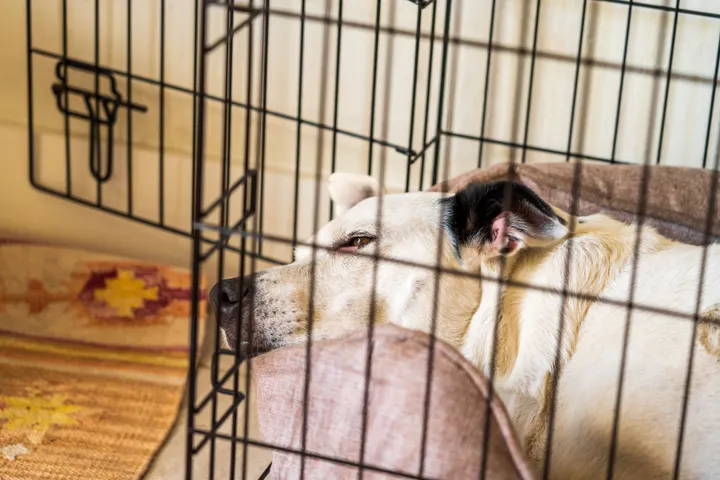
Strict rest means controlling nearly every opportunity for spinal bending, twisting, jumping, running, and sudden acceleration. For a medically managed disc episode, the ACVIM consensus recommends at least four weeks of restricted activity, ideally in a crate or a small room without furniture. Your veterinarian may prescribe a different duration based on the location, severity, response, and whether surgery occurred. “Taking it easy” on the couch is not equivalent because a dog can jump down or launch toward a door in seconds.
The recovery area should be large enough for the dog to stand, turn carefully, and lie fully extended, but not large enough to pace, run, or play. Use nonslip footing and supportive, washable bedding. Keep water available in a stable container. Food puzzles may reduce boredom only if they do not cause vigorous twisting, pawing, or bouncing. Place the enclosure where the dog can remain calm and included without being stimulated by door traffic, children, or other pets.
Outside the enclosure, use only the activity specifically allowed by the veterinarian. Toilet trips are typically short, controlled, and on leash. No stairs, furniture, zooming, off-leash sniffing, rough play, or greeting visitors. Pain improvement is not proof that the disc has healed. Medication can make a dog feel ready before the injured tissues are ready.
For related mobility guidance, read Why Is My Dog Limping? When to Wait and When to See a Veterinarian.
How Do You Safely Lift and Move a Dog With Back Pain?
Support the chest and pelvis at the same time so the spine remains as level and neutral as practical. For a small dog, slide one forearm under the chest behind the front legs and the other under the pelvis, then lift the body as one unit close to your torso. Avoid letting the rear end dangle. Do not lift by the front legs, scruff, abdomen, or harness alone. Move slowly and set the dog down on a nonslip surface without allowing a jump.
A larger dog may need two people. One person supports the chest and shoulders while the other supports the pelvis and rear limbs, coordinating the lift before moving. A firm board or folded blanket can function as a stretcher during emergency transport, especially after trauma or when the dog cannot stand. Keep the head and neck aligned if cervical pain is suspected. Do not force the neck into a “straight” position if that increases pain.
For bathroom breaks, the veterinary team may recommend a chest harness, rear-support sling, or both. A towel under the abdomen can be a temporary sling for some dogs, but it may press on the bladder or slip. Ask the team to demonstrate the equipment before discharge. Never allow a weak dog to drag across pavement, stairs, or rough flooring.
How Are Pain and Inflammation Managed?
IVDD pain may come from diseased discs, spinal cord and nerve-root compression, muscle spasm, and inflammation. Veterinarians may use a multimodal plan, meaning medicines with different targets are combined so no single drug has to carry the entire burden. The exact prescription depends on the dog’s neurologic status, kidney and liver health, gastrointestinal history, age, other medications, and whether surgery is planned.
Nonsteroidal anti-inflammatory drugs and corticosteroids should not be combined casually because the risk of gastrointestinal ulceration and other adverse effects can increase. Owners must disclose every medication, supplement, injection, and leftover product already given. Sedating medicines may be prescribed to support rest, but sedation does not stabilize the disc and does not replace monitoring. Call for vomiting, black stool, diarrhea, refusal to eat, unusual agitation, marked sedation, breathing changes, or worsening weakness.
Do not alter doses, stop medication abruptly, or add human pain relievers without veterinary direction. Ibuprofen, naproxen, and acetaminophen can be dangerous to dogs. If pain remains severe despite the prescribed plan, the question is not simply what else can be given. Persistent pain may change the recommendation for imaging or surgery.
What Home Nursing Does a Weak or Paralyzed Dog Need?
A weak or paralyzed dog may need assistance with turning, bedding, skin protection, toileting, and bladder care. Keep bedding dry and smooth. Check the hips, ankles, paws, and elbows at least daily for redness, moisture, abrasions, or pressure sores. Reposition a dog who cannot shift independently according to the veterinary team’s instructions. Protect dragging paws with appropriate support only when recommended; poorly fitted wraps can trap moisture, impair circulation, or create new wounds.
Bladder management is a medical task. Some dogs cannot empty the bladder voluntarily even though urine leaks out. An overfull bladder can cause discomfort, urinary infection, and loss of bladder tone. The veterinarian should determine whether the dog is urinating normally and, if needed, teach manual bladder expression or arrange catheter-based management. Do not rely on a wet bed as proof that the bladder emptied. Note urine stream, frequency, odor, color, and effort.
Monitor bowel movements, food and water intake, comfort, temperature if directed, and medication administration. Keep a daily log of walking ability, paw placement, urination, pain episodes, and videos of safe, necessary movement. A trend is often more useful than a single good or bad moment.
Can Laser Therapy or Rehabilitation Help?
Physical rehabilitation can support recovery by protecting joints, maintaining circulation, rebuilding strength, and retraining movement, but timing and technique must match the injury. During the acute phase, unsupervised stretching, massage, balance work, swimming, or repeated walking can be harmful. The veterinarian or neurologist decides when controlled exercises are appropriate. A certified canine rehabilitation professional may then guide passive range of motion, supported standing, assisted walking, underwater treadmill work, and progressive strengthening.
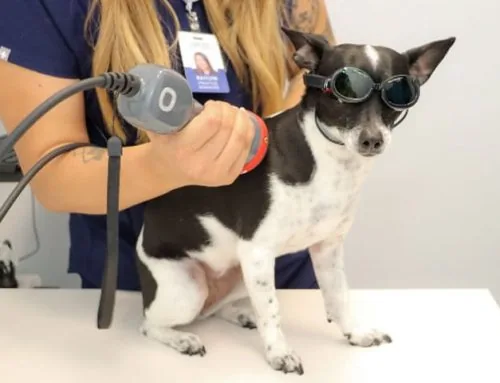
Photobiomodulation, commonly called veterinary laser therapy, may be used as an adjunct for selected painful or recovering patients. It should not be presented as a way to remove compressive disc material or replace urgent decompression. Evidence and protocols vary, and treatment settings depend on the target tissue, coat, size, depth, and diagnosis. The first step remains accurate localization and a treatment plan.
After surgery, rehabilitation may begin in the hospital with positioning and assisted movement, then progress according to incision healing and neurologic recovery. After medical management, activity should be reintroduced gradually only after the prescribed rest period and reassessment. A dog that becomes more painful, weaker, or less coordinated during rehabilitation needs immediate pause and veterinary review.
Bliss offers veterinary laser therapy in Lake Forest for selected patients when the diagnosis and treatment plan make it appropriate. It does not replace decompressive surgery, prescribed medication, or activity restriction.
How Do You Return a Dog to Activity and Reduce Future Risk?
Return to activity should be gradual and written down. A typical plan advances from brief, controlled leash walks on flat nonslip ground to slightly longer walks, then carefully selected strengthening exercises. The veterinarian may modify the pace based on gait, pain, fatigue, paw scuffing, and neurologic examination. Jumping, stairs, rough play, fetch, and off-leash running should not resume simply because the dog looks energetic. Muscle loss occurs during rest, so abrupt activity can overload both the spine and limbs.
Long-term risk reduction focuses on controllable factors without promising prevention. Maintain a lean body condition to reduce unnecessary mechanical load. Use gates to limit unsupervised stairs. Ramps may reduce jumping, but they must have a gentle slope, nonslip surface, side rails, and training so the dog does not leap on or off. A supportive harness can improve control, especially for neck disease, but it does not prevent disc degeneration. Keep nails and paw fur managed to improve traction, and place runners on slippery floors.
Recurrence can involve another disc. Ask which activities are appropriate for your dog’s body type, neurologic recovery, and lifestyle. Early recognition of renewed pain or wobbliness allows faster restriction and assessment.
IVDD Recovery: What Is Expected and What Requires a Call?
| What you notice | What it may mean | What to do |
| Comfort improving; walking stable or better; normal urination | The plan may be working, but the disc is not necessarily healed | Continue the full prescribed restriction and medications. Keep scheduled rechecks. |
| New wobbliness, knuckling, paw dragging, or repeated falls | Neurologic function may be worsening | Stop activity and call immediately for urgent reassessment. |
| Cannot stand or walk, new paralysis, or loss of voluntary urination | Severe spinal cord dysfunction | Go to an emergency veterinary hospital now. |
| Vomiting, black stool, refusal to eat, severe diarrhea, marked sedation | Possible medication adverse effect or concurrent illness | Call the prescribing veterinarian promptly; emergency care may be needed based on severity. |
| Incision swelling, discharge, opening, uncontrolled pain, or fever after surgery | Possible surgical complication | Contact the surgical team the same day; follow emergency instructions if rapidly worsening. |
Frequently Asked Questions
How long is crate rest for IVDD?
The ACVIM consensus recommends at least four weeks of restricted activity for medically managed acute thoracolumbar disc extrusion. Your veterinarian may prescribe a longer or different plan based on the individual case.
Can my dog sleep in bed during crate rest?
No. Beds and couches create fall and jumping risk, even with supervision. Use the prescribed enclosure with supportive bedding and controlled transfers.
Can I carry my dog around the house?
Only when necessary and with full chest and pelvic support. Repeated carrying for companionship increases handling and drop risk. Follow the veterinarian’s specific restrictions.
When can rehabilitation begin?
Timing varies. Some controlled nursing and rehabilitation begins early after surgery, while other exercises must wait. Start only with the treating veterinarian or rehabilitation professional’s approval.
Does surgery cure IVDD?
Surgery can remove current compressive disc material and improve recovery odds in selected dogs, but it does not reverse degeneration in every disc. Future episodes can still occur.
What if my dog seems normal after one week?
Continue the full plan. Pain control often makes a dog feel better before the disc and surrounding tissues are stable. Early freedom can lead to relapse or worsening.
Conclusion
Successful IVDD recovery depends on matching treatment to neurologic severity and then following the plan precisely. Conservative care is not simply pain medication; it requires veterinarian-directed restricted activity and close monitoring. Surgery does not eliminate the need for careful nursing and rehabilitation. In either pathway, worsening strength, coordination, urination, comfort, or function requires prompt reassessment.
For a stable dog whose veterinarian has recommended nonsurgical management or follow-up care, request an appointment with Bliss Animal Hospital in Lake Forest or call (949) 354-5201. A dog that becomes unable to stand or walk, loses bladder control, or develops rapidly worsening pain needs emergency evaluation.
Dog Back Pain and Supportive Care Services in Orange County, CA
Bliss Animal Hospital is located in Lake Forest and serves dog owners across South Orange County. These verified pages match the article’s general veterinary, urgent-care, or supportive-care topics:
About Bliss Animal Hospital
Our team, led by Dr. Nayara Pataro and Dr. Sam Amirshahi, is dedicated to providing compassionate, top-rated care right here in South Orange County. With a strong emphasis on relationships and personalized veterinary care, we’re here to support you and your pet’s health and happiness. If you’re looking for convenient, high-quality care nearby, check out our veterinarian services in Lake Forest, CA and surrounding areas like Veterinarian near Mission Viejo, CA, Irvine, CA Veterinarian (Great Park and Portola Springs) and vet near Rancho Santa Margarita, CA.



















Leave A Comment