
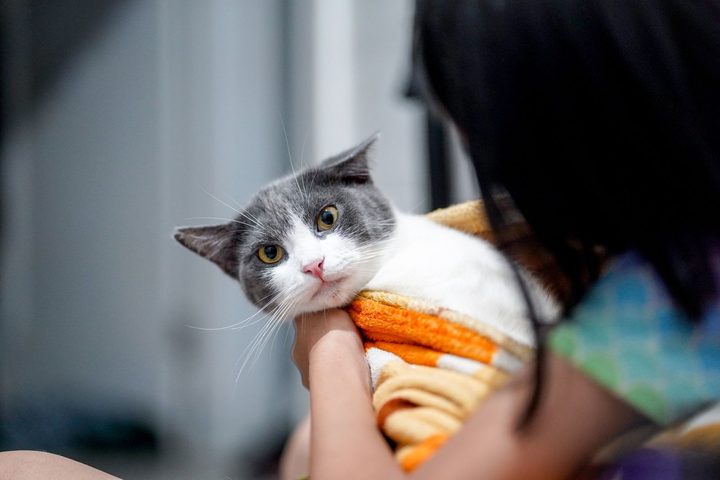
How Do I Give My Cat a Pill or Liquid Medicine If They Refuse It?
Top 3 Takeaways
Your cat eats the treat, walks away, and leaves the pill on the floor. Or you get the syringe into the side of their mouth only to see a puddle of pink liquid on the towel. If your cat refuses medicine, start with the least stressful method your veterinarian says is appropriate for that prescription. If that method isn’t working, stop rather than holding your cat tighter or making several attempts in a row. A different technique or a different form of the medicine may be a better fit.
This guide covers how to prepare, how pills and liquids differ, and what to do when you can’t tell whether the dose went in. If your cat is choking, breathing with an open mouth at rest, or working hard to breathe, don’t give anything else by mouth. Go to an emergency veterinary hospital now.
What should I check before I give my cat medicine?
Read the label and set everything out before bringing your cat over. Check your cat’s name, the medicine name, the prescribed amount, when it’s due, and any instructions about food, shaking, or storage. For liquid medication, use the oral syringe supplied or recommended for that prescription. Ask the veterinary team to show you exactly which line to use if the markings aren’t clear. Check a refill the same way you would a new prescription, especially if the label lists a different concentration, meaning a different amount of medicine in each milliliter. The volume you gave from the old bottle may not be the right volume for the new one.
Set up before you approach your cat
Choose a quiet spot where your cat can sit securely, such as a towel on a low, stable surface. Have the pill or measured liquid within reach, along with any food or follow-up your veterinarian approved. Don’t pull your cat out of a hiding place or interrupt them while they’re eating, grooming, or using the litter box. If your veterinary team shows you a gentle towel wrap and your cat tolerates it, it may help with positioning. It isn’t a way to hold down a cat who is fighting to get away.
If someone else in the household also gives the medication, use one shared note. Record the time and mark the dose as given, not given, or uncertain. “Uncertain” matters: it tells the next person not to assume the dose was either fully taken or safely available to give again. Keep the medication in its original labeled container and put it away as soon as you’re done.
How do I give my cat a pill if they won’t take it?
If the prescribing veterinarian says the pill can go with food, try offering it in a small bite your cat will eat willingly. If food isn’t allowed or your cat eats around the pill, ask for a hands-on demonstration before trying to place it directly in their mouth. Direct pilling means putting a tablet or capsule onto the tongue so the cat can swallow it. It takes coordination, not force, and it isn’t the right home technique for every cat. Before trying it, ask what should follow the pill. A tablet or capsule can lodge in the esophagus, the tube that carries food from the mouth to the stomach.
If food is allowed, hide the pill in one small bite
Use a small amount of an approved soft treat or wet food rather than hiding it in the entire meal. If your cat is willing, start with a plain bite, then offer the bite containing the intact pill. Watch what happens before providing the rest of the food. Some cats swallow the treat and leave the tablet behind, and others carry the bite away and drop it. Give the medicated bite separately from other pets so you know who ate it.
If your cat turns away from the medicated bite, don’t keep adding it to more of their regular food. You can make it harder to tell how much medicine they ate and may put them off a food they normally accept. A cat on a prescription diet or a food trial may have fewer suitable treat options, so ask the prescribing veterinarian what you can use.
If your vet shows you direct pilling, follow the pill with the approved chaser
When your cat is calm enough to be handled, use the position your veterinary team demonstrated. For a solid pill, the team may show you how to lift the chin gently, open the lower jaw, and place the pill toward the back of the tongue. Then let the mouth close, return the head to a natural position, and give your cat time to swallow. Watch for the pill to come back out. If you can’t open the mouth gently or you’re at risk of being bitten, stop. Ask whether a pill-giving tool or a different formulation would be safer.
Don’t plan to give the pill dry. Ask whether to follow it with an approved bite of food or a small amount of water, and have the team show you how to offer that follow-up safely. If your cat won’t swallow the recommended follow-up or starts coughing, don’t force it. Stop and call for guidance.
How do I give liquid medicine without squirting it down my cat’s throat?
Give liquid medicine slowly into the side of your cat’s mouth, with the head in a natural, level position. Don’t tip the nose upward as you might for a solid pill, and don’t aim the syringe straight down the throat. The goal is to let your cat swallow each small amount before you give more. A fast push can send liquid toward the airway instead of giving your cat time to swallow. If your cat will lick the prescribed liquid from the tip, you may be able to give it that way, provided you can confirm they’ve taken the full amount.
Use the side of the mouth and pause between small amounts
- Measure before you start. Shake the bottle only if directed, then draw up the prescribed amount in the recommended oral syringe. Check the marking at eye level.
- Bring the syringe in from the side. Place the tip just inside the corner of the mouth, behind the long canine tooth. Aim across the tongue rather than straight back toward the throat.
- Press the plunger a little at a time. Pause so your cat can swallow and breathe. If your cat starts to struggle, cough, or gag, stop rather than trying to empty the syringe.
- Watch what happens afterward. Some liquids taste bitter and can cause drooling or foaming. Foam doesn’t tell you how much medicine was swallowed. Note what you saw instead of estimating what needs to be replaced.
If the main problem is the amount of liquid your cat has to swallow, say that when you call. “They tolerate the syringe, but start pulling away halfway through” helps the team distinguish a handling problem from a problem with the volume or taste. Ask whether a different form or concentration is appropriate. Don’t make that change yourself or reuse the old volume instructions for a new concentration.
When should I stop and call the vet?
Stop if your cat is trying to bite or escape, if giving the medicine causes coughing or gagging, or if you can no longer tell how much they’ve swallowed. If your cat is breathing normally but the dose was missed, partly taken, or vomited, call the prescribing team the same day for instructions, ideally before the next dose is due. Keep the label in front of you. Tell them when you tried, when the last confirmed dose was given, and what you actually saw. “I found a partly dissolved tablet on the towel” is more useful than guessing that your cat swallowed half.
| What you notice | What to do |
| Your cat spits out a pill, leaves medicated food unfinished, or dribbles liquid but is otherwise acting normally. | Call the prescribing vet the same day. Describe what came back out. Don’t repeat the dose, give a partial top-up, or double the next one unless instructed. |
| Your cat coughs or gags during dosing, then settles and breathes normally. | Stop dosing and call the vet promptly. Tell them whether the cough continued or returned. If breathing becomes difficult, go to an emergency veterinary hospital. |
| You may have given an extra dose or the wrong medication. | Call immediately, even if your cat looks normal. Keep the packaging handy. If your vet is unavailable, contact an emergency veterinary hospital or animal poison control center. |
| Your cat is choking, breathing with an open mouth at rest, or struggling to breathe. | Go to an emergency veterinary hospital now. Don’t give more medicine, food, or water by mouth. |
If attempts keep failing but your cat is otherwise well, ask the prescribing team for a demonstration or a plan you can follow consistently. Tell them whether the problem starts when you approach, when you touch your cat’s face, or only when the medicine reaches their tongue. Mention new signs such as reduced appetite, vomiting, or trouble swallowing even without medication. Those details can help the veterinarian decide whether to focus on technique, reconsider the prescription format, or examine your cat for a problem that makes swallowing uncomfortable. Bliss offers pet urgent care in Lake Forest during business hours for concerns that need prompt attention but are not immediate emergencies.
Frequently Asked Questions
Can I mix it with food?
Only if the prescribing veterinarian approves it for that exact medicine and your cat’s diet. Use a small, separate portion you can watch your cat finish. If the label says “with food,” ask whether a treat is enough or a meal is needed.
What if my cat spits it out?
Don’t give a replacement dose until the prescribing team advises you. Tell them whether you found a whole pill, a chewed piece, or only liquid or foam. If you recover the pill, keep it out of reach of other pets.
Can I crush a pill or open a capsule to make it easier?
Only if your veterinarian confirms it’s safe for that exact prescription. Some products are designed to stay intact, and crushing can also expose a bitter taste. Ask whether you can use the pill whole in an approved treat or switch forms.
Is liquid medicine always easier than a pill?
No. Some cats swallow a small tablet in an approved treat but resist a syringe or dislike the liquid’s taste. If the current form doesn’t work, ask whether a smaller tablet, a flavored liquid, or another option is appropriate.
What if my cat vomits after taking the medication?
Call the prescribing team before giving more, even if you see what looks like part of the pill. Tell them how soon the vomiting happened and whether it has happened again. A visible pill fragment doesn’t tell you how much was absorbed.
Conclusion
The best way to give your cat medicine is the one you can repeat safely and that fits the prescription. Use food only when approved, give liquids slowly from the side, and ask what should follow a pill. If the dose is uncertain, set the medicine aside and call rather than trying to make up the difference.
If Bliss Animal Hospital in Lake Forest prescribed your cat’s medicine and giving it at home isn’t working, contact our veterinary team for help with the next dose. For a missed or uncertain dose, call (949) 354-5201 rather than waiting for an online reply.
Help With Cat Medication in South Orange County, CA
Bliss Animal Hospital is in Lake Forest and serves families in nearby South Orange County communities. If your cat needs an exam to find out why taking medicine has become difficult, learn more about feline veterinary care in Lake Forest.
About Bliss Animal Hospital
Our team, led by Dr. Nayara Pataro and Dr. Sam Amirshahi, is dedicated to providing compassionate, top-rated care right here in South Orange County. With a strong emphasis on relationships and personalized veterinary care, we’re here to support you and your pet’s health and happiness. If you’re looking for convenient, high-quality care nearby, check out our veterinarian services in Lake Forest, CA and surrounding areas like Veterinarian near Mission Viejo, CA, Irvine, CA Veterinarian (Great Park and Portola Springs) and vet near Rancho Santa Margarita, CA.


















Leave A Comment